


 English
 Español
 русский
 Deutsch
 عربى
عربى
4-Season Tent Guide: What It Is, When You Need One, and How to Choose One
Content
- 1 What Actually Makes a Tent Four-Season
- 2 Four-Season and Three-Season Tents at a Glance
- 3 When a Four-Season Tent Earns Its Weight, and When It Does Not
- 4 The Details That Decide Whether You Sleep Well
- 5 Single-Person, Two-Person or Basecamp
- 6 Ventilation and Condensation
- 7 A Short Checklist Before You Buy
- 8 How Four-Season Tents Get Made
- 9 Bringing It Back to the Weather
A four-season tent is a specific piece of equipment, not a marketing upgrade. What keeps a shelter standing on an exposed ridge is not the label on the stuff sack, but a handful of design decisions: how the poles are arranged, how much mesh sits in the inner tent, and how well the fly sheds wind, snow and rain.
We have been building tents in Ningbo for more than twenty years. This guide covers what a four-season tent actually is, when it is worth the extra weight, and which details to check before you buy or specify one.
What Actually Makes a Tent Four-Season
A four-season tent is engineered to keep working when the weather turns serious. Three traits separate it from a summer model.
- A stronger pole structure. More poles, more crossing points and aluminum alloy rather than fiberglass, so the frame distributes snow load instead of bending under it.
- Less mesh. The inner tent is mostly solid fabric, which traps warmth and blocks spindrift, and also makes these tents stifling in July.
- A fuller fly and a larger envelope. The fly reaches closer to the ground, guy-out points are reinforced and more numerous, and vents can be closed once the wind picks up.
Labels such as 3+, 3-4 season or expedition usually signal a hybrid: a mesh-heavy inner paired with a pole set that can survive an early snowstorm. They are useful, but still a compromise, so know which half you are buying.
Four-Season and Three-Season Tents at a Glance
The table below compares the two shelter types by the features you actually notice in camp.
| Feature | Three-season tent | Four-season tent |
|---|---|---|
| Inner tent | Mostly mesh for airflow | Mostly solid fabric, minimal mesh |
| Pole structure | Two or three poles, often fiberglass | Three to five aluminum alloy poles, more crossings |
| Snow load | Not designed to carry snow | Frame built to shed and support snow |
| Ventilation | Relies on mesh panels | Closable vents placed for cross-flow |
| Packed weight | Lighter for the same footprint | Heavier fabrics and pole set |
| Warm-weather comfort | Comfortable and airy | Hot and humid inside |
| Typical conditions | Late spring to early autumn | Winter, alpine and shoulder season |
When a Four-Season Tent Earns Its Weight, and When It Does Not
The right tent depends on where and when you camp. A four-season tent is worth the extra grams in these situations:
- Winter and snow camping, where the frame must carry fresh snow without deforming.
- Alpine terrain and exposed ridgelines, where gusts arrive without warning.
- Shoulder-season mountain trips, where a mild forecast can turn into a snowstorm overnight.
- Long routes across several climate zones, where the shelter must handle the worst night rather than the average one.
Just as often, it is the wrong purchase:
- Summer camping and warm-weather backpacking, where a near-solid inner turns into a greenhouse.
- Low-elevation family camping, where extra weight and cost bring no benefit.
- Trips where space and airflow matter more than storm resistance.
If your trips sit in between, a well-built three-season tent with a full-coverage fly, or a hybrid 3-4 season model, will usually serve you better, and the saved weight is better spent on a warmer sleeping system.
The Details That Decide Whether You Sleep Well
Once a four-season tent belongs in your kit, the differences between models come down to a few technical details, which are also worth discussing with a manufacturer when sourcing for a brand.
Pole Structure and Load Path
Aluminum alloy poles are the default for winter, because they bend rather than shatter and can be repaired with a splint. A dome with three or four crossings is far stiffer than a simple two-pole tunnel. Thicker poles resist deflection at the cost of weight. Sleeves hold poles more securely in wind, clips pitch faster, and many expedition designs combine both.
Fabrics, Coatings and Waterproofing
Flys are usually ripstop nylon or polyester. Silicone-coated 20D nylon suits weight-critical use, while coated polyester offers better UV resistance and price. A hydrostatic head of 3000 mm is a reasonable floor for the fly, and 5000 mm or more for the groundsheet. Taped or seam-sealed seams matter as much as the headline number.
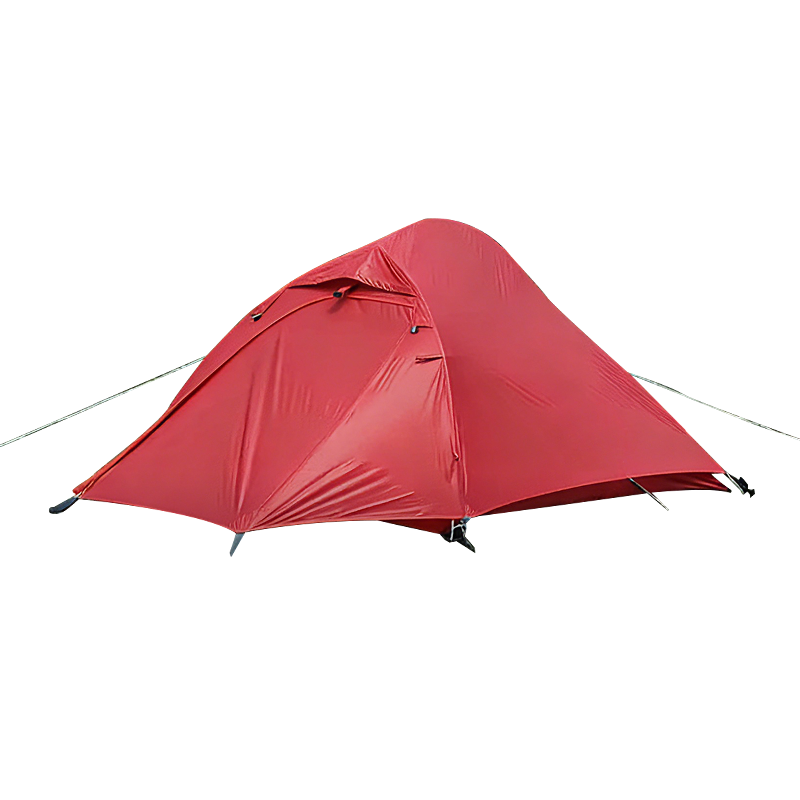 Lightweight 1–2 Person 20D Silnylon Hiking TentA 1–2 person backpacking tent in 20D silnylon ripstop with PU3000 waterproofing, aluminum poles, and mesh inner for breathability; suited to lightweight hiking and camping.View Product →
Single-Person, Two-Person or Basecamp
Interior volume is constrained by the solid inner and bulky sleeping bags, so sizing differs from a summer tent.
- One person. Solo four-season tents are narrow and often tapered, so check the interior length if you are tall, and make sure the vestibule fits a pack and boots.
- Two people. Sharing usually wins, since a two-person tent carries less per head than two solo shelters.
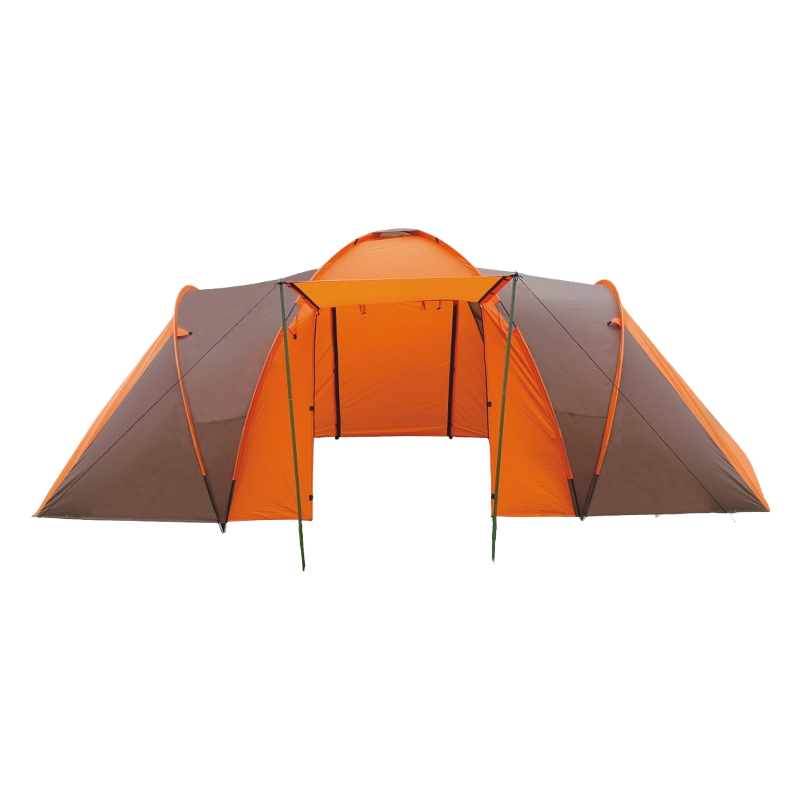
- Groups and basecamps. Three and four-person models, or larger tunnel designs, suit a fixed camp.
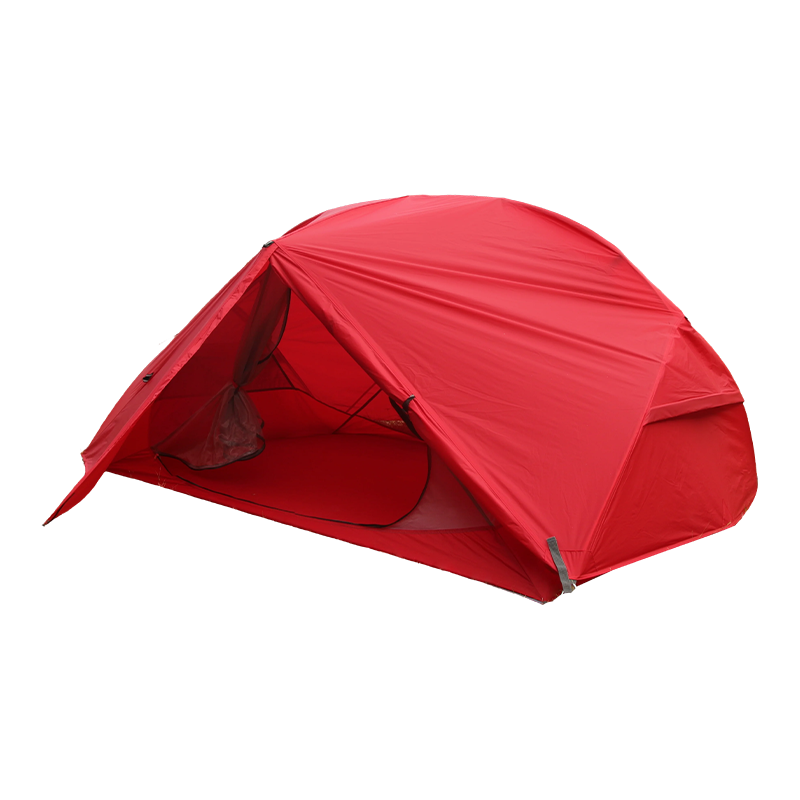 Lightweight 1 Person 20D Ripstop Hiking TentSingle-person 20D ripstop tent with PU3000 waterproofing, B3 mesh ventilation, and 7001 aluminum poles for backpacking, hiking, and camping in wet conditions.View Product →
Ventilation and Condensation
Most winter discomfort comes from moisture. A closed tent with no airflow collects condensation from breathing and cooking, and by morning the inner walls are wet or icy. A double-wall design, with an air gap between inner and fly, keeps moisture away from the sleeping area, and high and low vents opening in opposite directions create cross-flow without letting rain in.
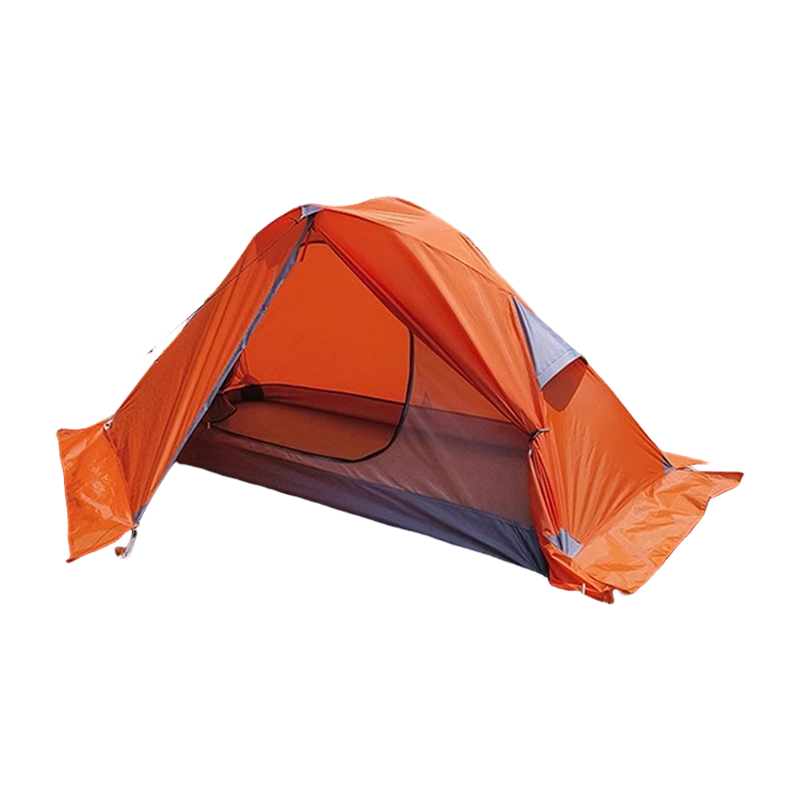 Single-Person Lightweight Double-Layer Hiking TentA double-layer solo tent with 210T polyester fly, B3 mesh inner, 210D Oxford floor, and aluminum poles; suited to hiking, backpacking, and wholesale orders.View Product →
A Short Checklist Before You Buy
Whether shopping for yourself or specifying a container of tents, confirm these points first.
- Hydrostatic head: at least 3000 mm on the fly and 5000 mm on the floor.
- Pole specification: aluminum alloy, stated diameter and number of crossings.
- Wall construction: double wall, with a fly that can be pitched first in rain.
- Ventilation: at least two closable vents positioned for cross-flow.
- Guy-out points: reinforced and numerous, with reflective line and sturdy stake loops.
- Packed weight and volume: measured honestly rather than rounded down.
- Spare parts: pole sections, repair patches and a clear replacement policy.
How Four-Season Tents Get Made
Most four-season tents come out of factories like ours in Ningbo, where design, fabric cutting, pole assembly and testing happen under one roof. Kaima has been in outdoor tent manufacturing for over twenty years, and our in-house design team can adjust pole diameter, fly fabric, inner configuration, colour, logo and packaging.
We have written before about the rise of ultralight four-season tents for long-distance backpackers, a shift that shows up regularly in our custom enquiries.
Our quality control runs from raw materials to finished goods, testing waterproofing, wind resistance and durability before packing. When a result falls short, the finding goes back into the design rather than into the shipment.
Bringing It Back to the Weather
A four-season tent is not a badge of seriousness; it is a tool matched to conditions. If your camping runs into winter or onto exposed alpine ground, the extra poles, solid fabric and fuller fly will pay for themselves the first time the weather turns. If not, a good three-season or hybrid shelter will keep you drier, cooler and lighter. The useful thing is to know which one you are buying, and why.
-
25 Sep, 2026
Two in the morning. The tent walls are beaded with moisture, the sleeping bag feels damp, and the air inside is stale. This is a familiar scenario for campers ...READ MORE
-
27 Aug, 2026
A buyer once showed us two lightweight hiking tents with the same floor space. One weighed 1.6 kg and the other 2.4 kg. Both had a rain fly and two doors. One ...READ MORE
-
18 Sep, 2026
You unzip the tent, and the smell hits you first: damp earth, condensation, and the faint sour note of a storm that passed two nights ago. A tent that has been...READ MORE
-
11 Sep, 2026
At a Saturday farmers market, two coffee stalls stand forty meters apart. One operates under a plain grey canopy. The other has its name, its brand colors and ...READ MORE
-
03 Sep, 2026
Two beach tents can look identical in a supplier's catalog and still behave nothing alike after three weekends on a windy shoreline. The cheaper one sags becau...READ MORE
-
02 Apr, 2026
Understanding Your Family’s Camping Needs Choosing the right camping tent starts with a clear understanding of your family’s actual needs. Many buyers make the ...READ MORE
-
+86-15867893553
- km@kaima-outdoor.com
- 6th Floor, Building 8, Wanyang Innovation City, Baifeng Street, Beilun District, Ningbo City, Zhejiang Province, China.
Copyright © Ningbo Kaima Outdoor Products Co., Ltd.All Rights Reserved.
 Custom Outdoor Lightweight/Packable Tent Manufacturers
