


 English
 Español
 русский
 Deutsch
 عربى
عربى
How to Choose a Pop Up Tent with Logo for Events, Trade Shows, and Brand Promotions?
Content
At a Saturday farmers market, two coffee stalls stand forty meters apart. One operates under a plain grey canopy. The other has its name, its brand colors and a short tagline printed across the roof and valance, readable from the entrance gate. By mid-morning the second stall has a line, and part of the reason is that customers spotted it before they decided where to buy.
For any business that sells face to face — markets, trade shows, sporting events, beachfront rentals, product sampling — a pop up tent with logo is the most practical branding purchase you can make, because the shelter was a necessary cost anyway and the print turns it into signage. The difference between a logo that survives one season and one that survives five comes down to three things: the printing method, the fabric and coating underneath it, and whether the factory runs proper tests before shipping. This article works through each of those decisions from the manufacturer's side of the table.
What a Logo Actually Does for a Pop Up Tent
A standard 3×3 m canopy offers roughly nine square meters of printable roof surface, and the valance band around the edge adds another visible strip at eye level. No banner you carry to the event gives you that area, and no banner holds up in wind and drizzle the way a coated oxford canopy does. Because the tent is reused across events, the cost of the print drops every time it goes up.
The branding also does quiet work between transactions: it marks your position on a crowded field, keeps late arrivals findable, and photographs consistently when customers post from your stand. Treat the tent as fixed signage that happens to fold into a bag, not as an accessory.
Printing Methods for Logo Canopies
Three printing methods cover nearly all custom canopy work. The right choice depends on how many colors your logo uses and how many units you order.
Screen printing
Screen printing pushes ink through a mesh screen, one screen per color. It produces a thick, opaque ink layer that resists fading and abrasion, which makes it the default for simple one-to-three color logos on large orders. The trade-off is setup: every color adds a screen, so photographic artwork or gradient-heavy designs become expensive quickly.
Heat transfer
Heat transfer prints the design onto carrier film and bonds it to the fabric under heat and pressure. It handles fine detail and mid-size runs well and keeps colors consistent across the whole order. Expect a slightly stiffer feel on the printed area compared with direct methods.
Dye sublimation
Dye sublimation turns ink into gas and bonds it inside the polyester fibers, so the print cannot crack or peel. It is the only practical route to full-color, edge-to-edge coverage — photographic backdrops, repeating patterns, all-over campaign graphics. Because there are no per-color screens, it also suits shorter runs and frequent artwork updates.
| Method | Best for | Color handling | Durability | Cost behavior |
|---|---|---|---|---|
| Screen printing | Simple logos, 1–3 colors, large volumes | One screen per color | High, thick ink layer | Cheapest per unit at volume, high setup cost per color |
| Heat transfer | Fine detail, mid-size runs | Full color on film | Good, bonded layer | Moderate setup, stable unit cost |
| Dye sublimation | Photographic and all-over graphics | Unlimited colors | Highest, ink bonded inside fiber | No per-color setup, favorable for short runs |
Construction matters as much as the method. On a double-layer automatic pop-up tent, the printed outer fly carries the graphics while the inner ceiling stays clean and unprinted, which is the finish most brands prefer for trade show interiors.
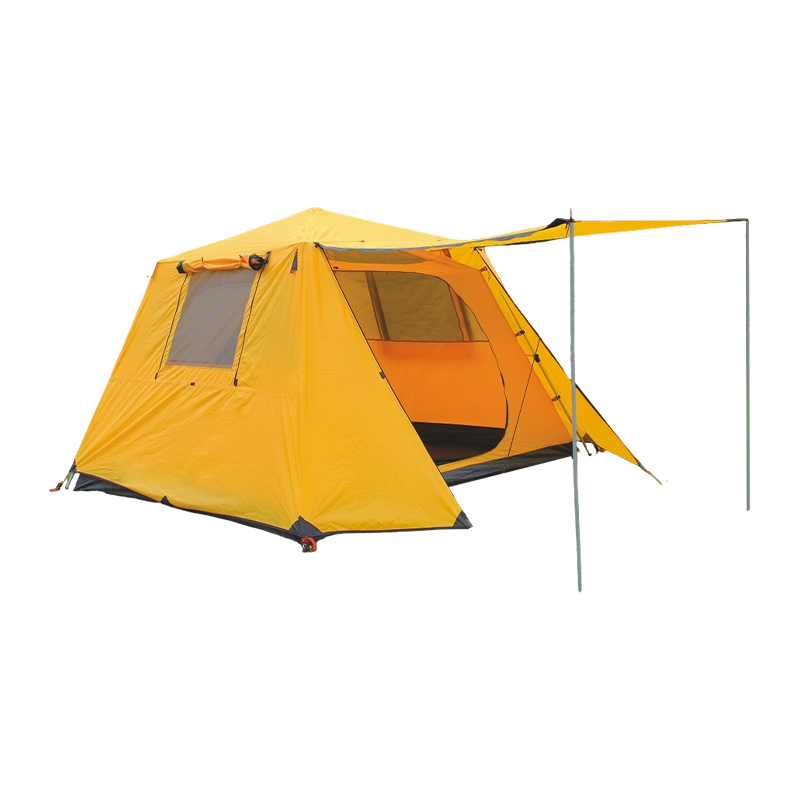
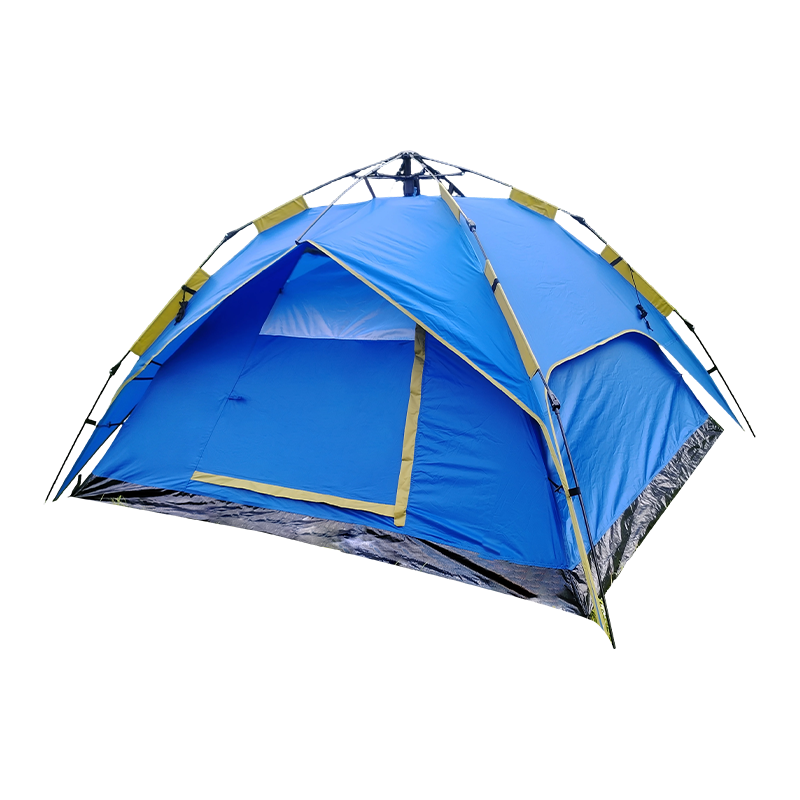 Double-Layer Automatic Pop-Up Tent with Printed Outer FlyMeasuring 210 × 210 × 130 cm with 190T PU2000 fabric and automatic fiberglass spring poles, this double-layer tent suits trade show use, where the printed outer fly displays graphics while the inner ceiling stays clean.View Product →
Frame and Fabric Specs to Confirm Before Sampling
The frame decides how long the tent survives; the fabric decides how the logo looks and how the canopy handles weather. Confirm both in writing before sampling starts.
Steel wire frames are the budget workhorse: heavy, rigid and economical, though they depend on good coating quality to resist rust, especially near the coast. Fiberglass poles flex in wind and weigh less, which suits beach and casual market use. Aluminum alloy frames cost more but resist corrosion, cut carrying weight and hold their geometry after repeated setups — the usual choice for teams that erect and strike the tent weekly.
On fabric, oxford polyester from 150D to 600D is the standard canopy material. A PA or PU coating handles drizzle and morning dew; a full PVC coating is the specification for sustained rain. For sun-facing activations, a titanium black coating blocks light and raises UV protection — we apply a 150D oxford fabric with titanium black coating across our outdoor canopy line, and 170T PA-coated fabric on several automatic tent models. Ask for fabric weight, coating type and UPF rating on the spec sheet, not just the word "waterproof".
For high-volume orders where unit cost dominates, the automatic steel wire frame tent is the base most buyers start from.
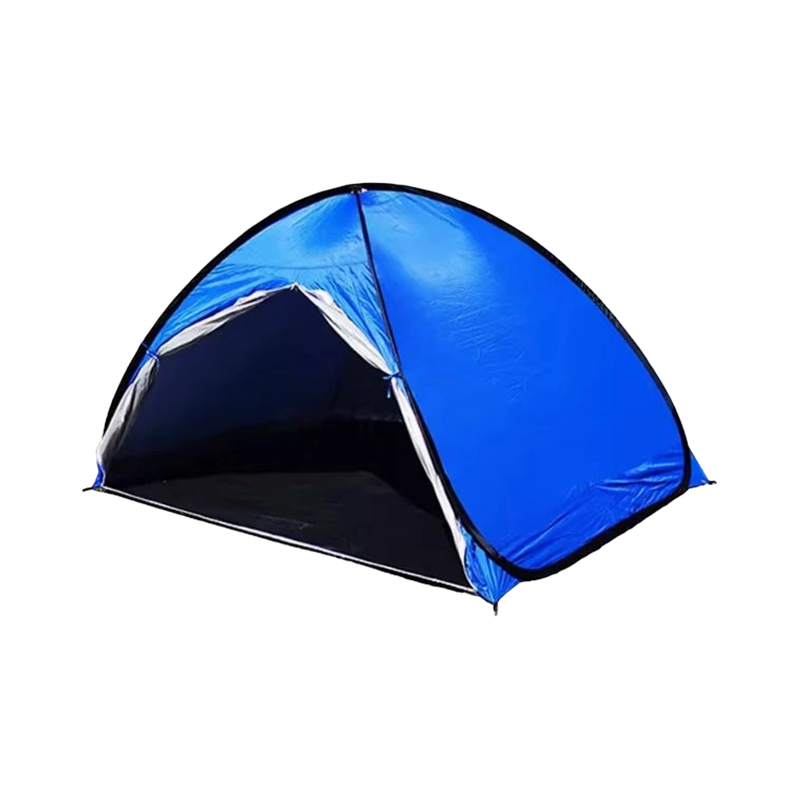 Automatic Steel Wire Frame Tent for High-Volume OrdersSized 210 × 135 × 120 cm with 170T PA silver coating and a flat steel wire frame, this pop-up tent is a cost-efficient base option for buyers prioritizing unit price on large custom orders.View Product →
Where a Branded Pop Up Tent Works Hardest
- Farmers markets and food stalls: weekly reuse, the logo visible from the gate, and a roof print that photographs well in customer posts.
- Trade shows and expos: booth identification when halls and outdoor zones are crowded with similar-looking stands.
- Sports events: registration desks, finish-line arches and sponsor zones, where setup has to happen in minutes.
- Beach clubs and rental zones: shade plus branding, with blackout-coated fabric keeping the interior usable under strong sun.
- Sampling tours and roadshows: the tent is the campaign, packed into a vehicle and rebuilt in a new city each week.
For larger sites, brands often pair a printed tent with a canopy to extend the shade area without buying a second full tent — a 280×240 cm multipurpose sunshade canopy covers a seating or product-display zone right beside the main booth.
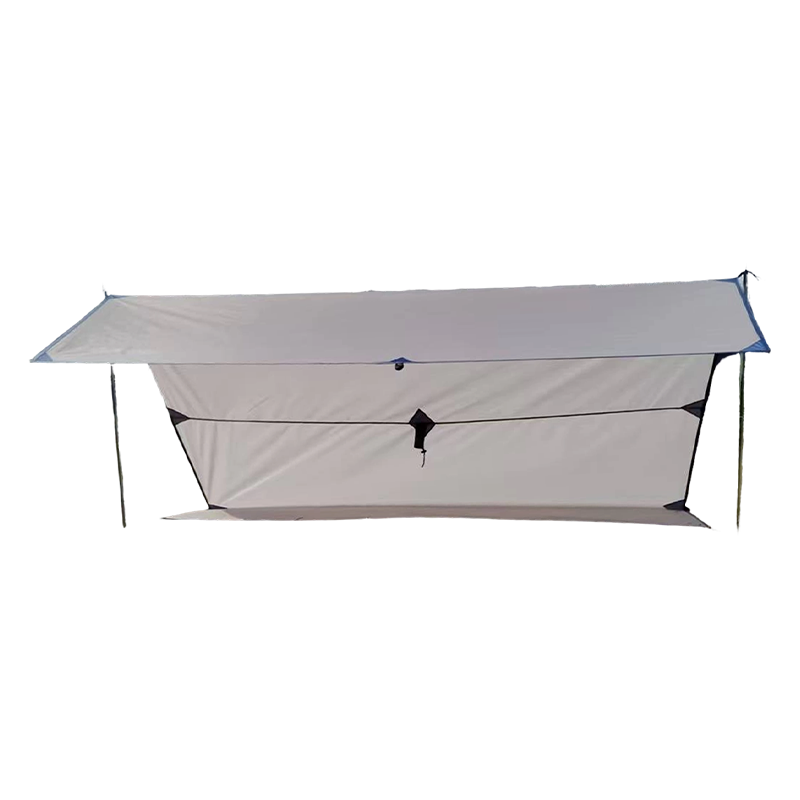 280x240 cm Multi-Purpose Outdoor Sunshade CanopyBuilt from 210T PU2000 fabric with UV50+ protection, this lightweight canopy extends shade beside a main tent, covering seating or product-display zones at larger brand event sites.View Product →
How Custom Logo Production Runs at the Factory
Most delays in custom tent projects trace back to artwork, not production. Start with vector files — AI, EPS or PDF — and Pantone codes for every brand color, so the ink can be matched rather than approximated from a screen image.
- Send artwork and specifications: logo files, Pantone numbers, tent size, frame material, fabric weight and coating.
- Confirm the print layout: roof, valance, and whether graphics appear on one, two or all four sides.
- Approve a pre-production sample, checking color match in daylight rather than under indoor lighting.
- Mass production runs with in-line inspection from raw fabric through cutting, sewing and printing.
- Finished tents are tested for waterproofing, wind resistance and structural durability before packing.
- Goods ship from Ningbo, close to our plant and one of the world's busiest container ports, which shortens the gap between production end and vessel departure.
As a manufacturer, we accept bulk custom orders, and the minimum order quantity depends on size and printing method: screen printing becomes economical at higher volumes because of screen setup, while sublimation tolerates smaller batches. If you are comparing suppliers this season, our industry insight on the questions tent buyers are asking in 2026 covers the points procurement teams raise most often.
Quality Checks That Protect the Brand You Printed
A printed tent fails publicly. A seam that leaks or a logo that fades is visible to every customer at the event, which is why the inspection standard for a branded order should be stricter than for a plain one.
Our production follows a full-process monitoring system that tracks material through every stage to finished goods, so a problem found in the field can be located within the batch. Waterproofing, wind resistance and durability are tested with dedicated equipment, and results are recorded as data rather than impressions — the numbers matter when a client plans to run the tent through a full season of weekend events. Findings feed a continuous check-feedback-improvement loop, so recurring issues change the process, not just the individual unit. For buyers, the practical takeaway is to ask which tests are performed, request the results for your actual production batch, and inspect a random carton on arrival before the season starts.
A pop up tent with logo is a straightforward purchase once the variables are named: choose the printing method by artwork complexity and order size, lock the frame and fabric specifications before sampling, approve a daylight-checked sample, and insist on test data for the production batch. Do that, and the tent works as shelter, signage and advertising for years instead of a single season.
If you are still comparing base models, the automatic tent lineup spans steel-wire, fiberglass and aluminum frames, from compact changing tents to 4–8 person family units — pick the base that fits your events first, then add your logo.
-
23 Oct, 2026
Every tent we design starts with the same question: how will air get in, and how will it get out? Ventilation is the quiet feature that decides whether you wak...READ MORE
-
27 Aug, 2026
A buyer once showed us two lightweight hiking tents with the same floor space. One weighed 1.6 kg and the other 2.4 kg. Both had a rain fly and two doors. One ...READ MORE
-
16 Oct, 2026
Choosing a tent looks simple until you are standing in front of thirty of them. Two-person or four-person, pop-up or pole, silnylon or polyester. After more th...READ MORE
-
02 Apr, 2026
Understanding Your Family’s Camping Needs Choosing the right camping tent starts with a clear understanding of your family’s actual needs. Many buyers make the ...READ MORE
-
25 Sep, 2026
Two in the morning. The tent walls are beaded with moisture, the sleeping bag feels damp, and the air inside is stale. This is a familiar scenario for campers ...READ MORE
-
18 Sep, 2026
You unzip the tent, and the smell hits you first: damp earth, condensation, and the faint sour note of a storm that passed two nights ago. A tent that has been...READ MORE
-
+86-15867893553
- km@kaima-outdoor.com
- 6th Floor, Building 8, Wanyang Innovation City, Baifeng Street, Beilun District, Ningbo City, Zhejiang Province, China.
Copyright © Ningbo Kaima Outdoor Products Co., Ltd.All Rights Reserved.
 Custom Outdoor Lightweight/Packable Tent Manufacturers
