


 English
 Español
 русский
 Deutsch
 عربى
عربى
How Do You Choose a Beach Tent Factory You Can Actually Trust?
Content
Two beach tents can look identical in a supplier's catalog and still behave nothing alike after three weekends on a windy shoreline. The cheaper one sags because its coating was applied unevenly, wicks water through untaped seams, and cracks at a pole joint nobody load-tested. That gap is not a product problem. It is a factory problem. When you source from a beach tent factory, what you are really buying is process control: fabric inspection, coating consistency, stitch density, and finished-goods testing. Buyers who verify those four things before a first order rarely inherit a season of returns. Buyers who skip them usually find out in peak summer, when production slots are full and it is too late to fix.
What a Beach Tent Factory Actually Builds
Beach tents occupy a narrow but demanding niche. They are low-profile, daytime shelters, judged on three things: how completely they block the sun, how they hold up to wind on soft ground, and how fast a family can pitch them between the parking lot and the waterline. A factory that treats them as scaled-down camping tents gets the proportions wrong. A proper beach tent needs a lower center of gravity, a wider footprint, and anchoring designed for sand rather than grass or soil.
In practice, most manufacturers in this category produce a handful of recognizable formats:
- Canopy-style shelters, such as a 110 x 140 x 100 cm model whose extended front awning throws shade well beyond the main body.
- Low-profile wind shelters in the 170 x 120 x 105 cm and 270 x 120 x 120 cm range, built to sit close to the ground where gusts are strongest.
- Fishing tents with zippered doors, typically around 240 x 120 x 120 cm, letting an angler step inside, store gear, and watch the rods through mesh windows.
- Blackout-coated models that use a titanium black inner layer to cut glare and keep the shaded interior noticeably cooler.
- Pop-up and pre-attached frame designs aimed at casual users who will never read an instruction manual.
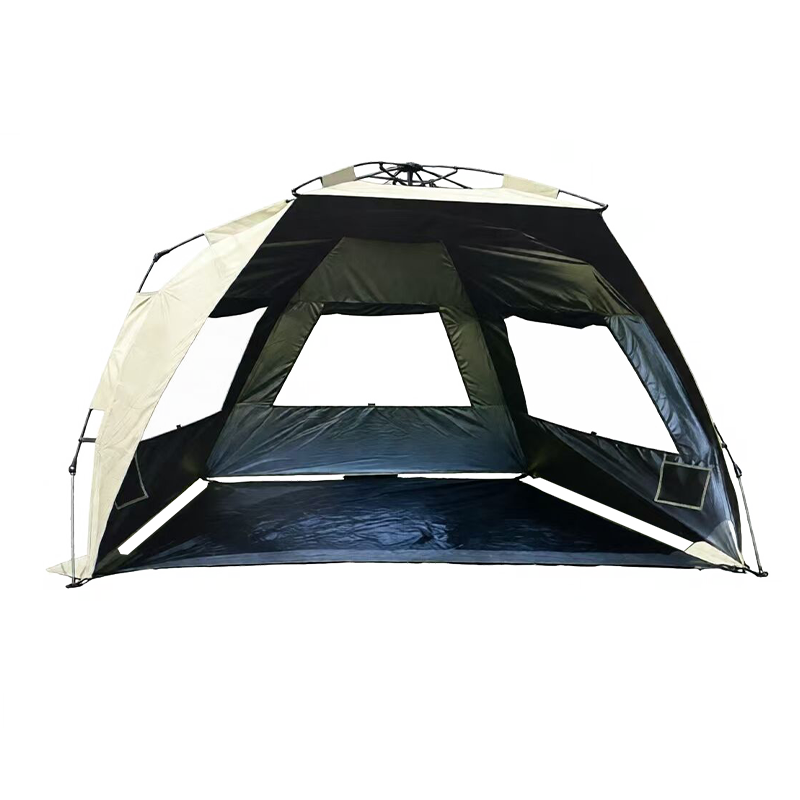 Titanium Blackout Sun Protection Beach Tent for TwoA pop-up 250×160×150 cm beach tent in 150D Oxford fabric with titanium black PU5000 coating, offering strong UV blocking and waterproofing. It illustrates the blackout-coating format within the beach tent range.View Product →
 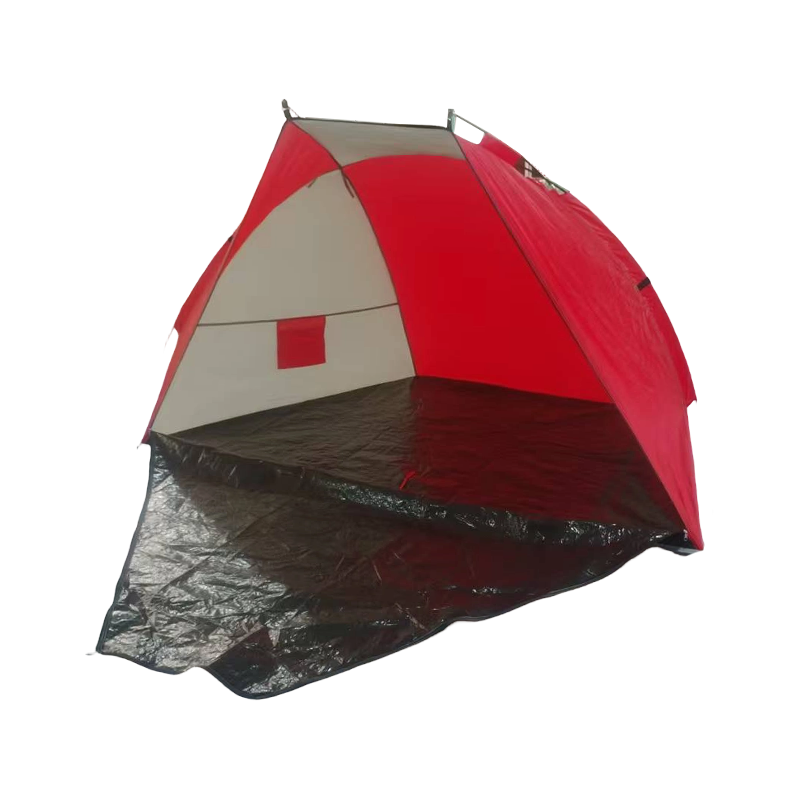 240x120x120 cm Fishing Tent with Front DoorA compact one-to-two person fishing shelter with 170T PA300-coated fabric, PE floor, and flexible 6.9mm fiberglass poles. It shows how tent formats adapt to anglers rather than family beach use.View Product →
A capable factory engineers across these formats instead of reskinning a single pattern. Pole geometry, door placement, and mesh positions all change depending on whether the tent serves a family beach day or an angler sitting through an afternoon tide. Reviewing a complete beach tent range side by side makes those engineering differences visible before you narrow the specification.
Materials and Specifications That Decide Quality
Fabric and coating choices explain most of the price spread between quotations that look similar on paper. Three decisions matter most.
Coatings and UV protection
Silver coating is the budget baseline: it reflects sunlight but degrades faster under constant UV exposure. A titanium black, blackout-style coating costs more, blocks far more light, keeps the interior cooler, and protects the fabric itself from sun damage. For any product marketed as sun protection, ask for the UPF or UV test data behind the claim, not just the wording on the hangtag. Base fabric matters as well. 170T polyester with a PA coating is the workhorse for beach tent canopies, while 150D oxford appears in heavier shelters and tarp products where abrasion resistance outweighs packed size.
Poles and frames
Fiberglass dominates beach tents for practical reasons. It flexes in gusts instead of bending permanently, and it does not corrode in salt air. Steel is cheaper per set but heavier and rust-prone once its coating is scratched. Aluminum is the premium choice where a weight budget exists, which is uncommon in this category.
Construction details that show up in customer reviews
Taped seams, dense stitching, mesh panels sized for real airflow, sand pockets wide enough for soft ground, and zippers that still run after a day of blowing sand. These details shape your return rate more than the fabric label does.
| Specification | Common Options | What to Verify Before Production |
|---|---|---|
| Fabric | 170T polyester, 150D oxford | Actual denier, weave consistency, incoming inspection records |
| Coating | PA coating, silver, titanium black | Coating weight in g/m2, uniformity, UV aging results |
| Poles | Fiberglass, steel, aluminum | Wall thickness, joint fit, corrosion resistance in salt air |
| Seams | Single, double, or taped stitching | Stitch density per inch, taping coverage at stress points |
| Ventilation | Mesh panels, cross windows | Mesh fineness, closure quality against blowing sand |
How to Evaluate a Beach Tent Factory Before You Commit
A reliable way to tell a manufacturer from a trading office is to ask who performs each step. A factory with genuine process control can answer specifically:
- Which inspections run on incoming fabric and coatings, and what acceptance thresholds are applied.
- How quality is monitored on the sewing line, including stitch density targets and seam taping coverage.
- Which finished-goods tests cover waterproofing, wind resistance, and durability, and whether results are reported as numbers rather than adjectives.
- How defects feed back into design changes through a documented inspection-feedback-optimization loop.
An established manufacturer will also run its own design team rather than outsourcing pattern work. Small changes, such as moving a door or resizing a mesh panel, need to be prototyped and tested in-house. Buyers across the outdoor industry are pressing on exactly these points, as we summarized in our overview of the key questions tent buyers are asking in 2026.
The sample tells you the rest. Request units cut from a current production run, not a showroom piece, and ask for the test report that matches the sample in your hand. A factory confident in its data sends both without hesitation. One that delays or substitutes answers has already told you something useful.
Customization, OEM, and the Details to Lock Down Early
Export-level beach tent factories accept batch customization, and the specification sheet decides whether the project runs smoothly. Beyond logo placement and packaging, agree in writing on:
- Dimensional tolerances: a variance of 2-3 cm on pitch dimensions is normal in cut-and-sew production, so a buyer expecting zero variance will reject acceptable goods.
- Fabric and coating substitutions, defined by coating weight in g/m2 rather than by color names.
- Pole material, diameter, and joint hardware, verified against an approved golden sample.
- Carton size and packed weight, which move landed cost as much as unit price does.
A fiberglass-pole beach tent is a common base platform for this kind of work, because the pole specification can be scaled up or down without redrawing the whole pattern, and the fabric can be upgraded to a blackout coating without touching the frame.
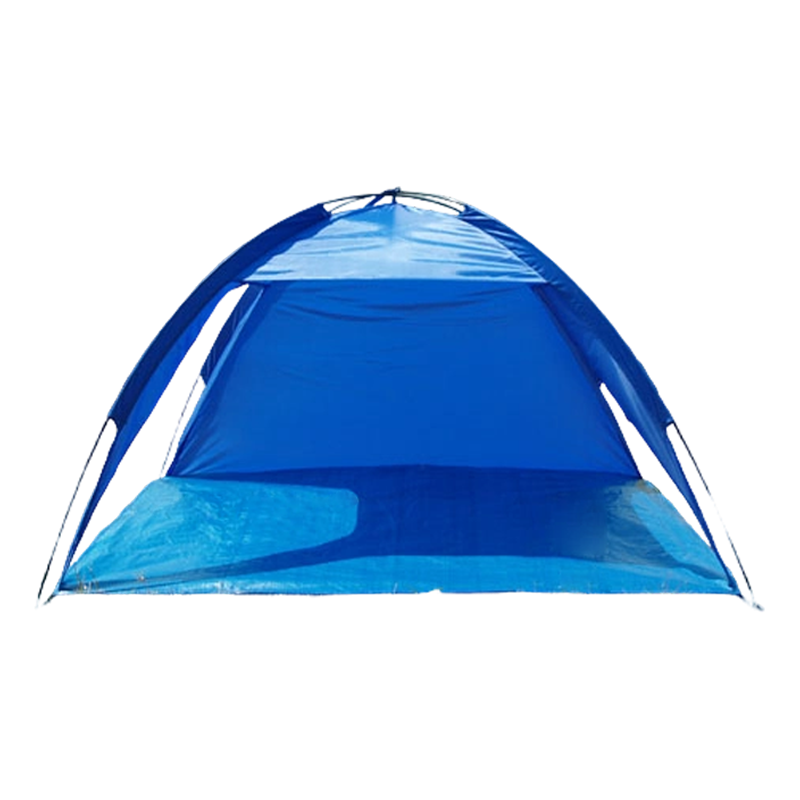 Beach Tent with Fiberglass Pole (240x120x120 cm)A lightweight 240×120×120 cm beach tent using 170T PA300 fabric, PE floor, and 6.9mm fiberglass poles for flexible, wind-tolerant stability. It serves as the common base platform for scaled variations.View Product →
Fix the golden sample, date it, and keep a signed reference copy. Every later dispute about color, coating, or stitching is resolved against that sample, not against memory.
Why the Factory's Address Affects Your Landed Cost
A manufacturer based in Beilun, Ningbo, close to a major container port, can compress lead times in ways that show up directly in cash flow. Short inland distance to the port means lower drayage, reliable vessel cut-off compliance, and less exposure during peak booking season. For buyers consolidating a range, proximity also makes mixed-container loading practical: beach tents, automatic camping tents, inflatable models, and lightweight hiking tents from one supplier can share a single container instead of moving through separate warehouses and inspections.
Multilingual sales coverage in English, Spanish, Russian, German, and Arabic is another practical signal: it shows which regions the factory already exports to and how much friction to expect in daily communication.
Next Steps for Buyers
The working sequence is short. Write the specification sheet with tolerances. Request a production-line sample together with its test data. Confirm customization scope, packaging, and carton details in writing. Then ask for a quotation that itemizes fabric, coating, pole, and packing costs, so that later negotiations happen over numbers instead of adjectives. A beach tent factory that handles those four steps transparently is showing you, in miniature, exactly how it will handle your production order.
-
09 Oct, 2026
Rain is the fairest test a tent will ever face. It finds the thin coating, the seam nobody taped properly, the floor that sits too low, and the ventilation tha...READ MORE
-
02 Oct, 2026
A four-season tent is a specific piece of equipment, not a marketing upgrade. What keeps a shelter standing on an exposed ridge is not the label on the stuff s...READ MORE
-
02 Apr, 2026
Understanding Your Family’s Camping Needs Choosing the right camping tent starts with a clear understanding of your family’s actual needs. Many buyers make the ...READ MORE
-
11 Sep, 2026
At a Saturday farmers market, two coffee stalls stand forty meters apart. One operates under a plain grey canopy. The other has its name, its brand colors and ...READ MORE
-
27 Aug, 2026
A buyer once showed us two lightweight hiking tents with the same floor space. One weighed 1.6 kg and the other 2.4 kg. Both had a rain fly and two doors. One ...READ MORE
-
16 Oct, 2026
Choosing a tent looks simple until you are standing in front of thirty of them. Two-person or four-person, pop-up or pole, silnylon or polyester. After more th...READ MORE


-
+86-15867893553
- km@kaima-outdoor.com
- 6th Floor, Building 8, Wanyang Innovation City, Baifeng Street, Beilun District, Ningbo City, Zhejiang Province, China.
Copyright © Ningbo Kaima Outdoor Products Co., Ltd.All Rights Reserved.
 Custom Outdoor Lightweight/Packable Tent Manufacturers
