


 English
 Español
 русский
 Deutsch
 عربى
عربى
Why Fully Automatic Tents Gain Ground Among Casual Outdoor Users?
Content
- 1 The Short Answer: Speed and Simplicity Drive the Trend
- 2 How the Automatic Opening Mechanism Actually Works
- 3 Materials That Keep the Tent Durable Despite Frequent Folding
- 4 Ventilation and Structural Stability in Everyday Conditions
- 5 Typical Situations Where Casual Users Choose Automatic Tents
- 6 A Practical Example: The Boat-Shaped Four-Person Automatic Tent
- 7 What Casual Buyers Should Consider Before Choosing One
The Short Answer: Speed and Simplicity Drive the Trend
Fully automatic tents are gaining traction among casual outdoor users mainly because they remove the steepest barrier to camping: setup time and technical skill. A traditional pole tent can take fifteen to thirty minutes to assemble correctly, often requiring two people and some trial and error with poles, clips, and guy lines. An automatic tent, by contrast, relies on a pre-tensioned, spring-loaded frame that pops into shape when released from its carry bag, typically taking only a few seconds. This near-instant deployment is a primary reason casual campers, families, and weekend travelers are shifting toward automatic designs rather than conventional pole tents.
How the Automatic Opening Mechanism Actually Works
The mechanism behind automatic tents is a continuous, high-elasticity frame, usually made from fiberglass rods bent into a curved or arched shape and held under tension by the tent's fabric shell. When packed, the frame is folded into a flat coil and secured inside a compact carry bag. Releasing the retaining strap allows the stored elastic energy in the fiberglass to snap the frame back into its designed shape, pulling the fabric taut in the process. Packing the tent back down does require a folding technique, usually a figure-eight twist, but once a user practices it a couple of times it becomes intuitive. This design also reduces the number of loose parts, since there are no separate poles to lose or mismatch, which lowers the chance of setup errors for people camping only a handful of times per year.
Materials That Keep the Tent Durable Despite Frequent Folding
Because the frame flexes every time the tent is opened and closed, material choice matters more than in a fixed-pole design. Most automatic tents use fiberglass poles around 6mm in diameter, chosen because the material can bend repeatedly without snapping while still returning to its original curve. The outer fabric is commonly a 210T polyester or nylon weave with a polyurethane coating rated near 2000mm, which is generally enough to handle steady rain and light wind exposure. The inner layer is usually a lighter, breathable fabric that allows airflow so condensation does not build up overnight. A polyethylene groundsheet is often bonded or sewn into the tent floor to resist moisture rising from damp grass or sand, and this layer also adds a degree of abrasion resistance when the tent is pitched on gravel or rocky ground.
Why Coating Ratings Matter
A PU coating measured at roughly 2000mm is generally considered suitable for moderate to heavy rain over short periods, which matches how casual users typically camp, usually one or two nights rather than extended expeditions. Seam taping at stitch points further reduces water seepage, an area where entry-level tents sometimes cut corners.
Ventilation and Structural Stability in Everyday Conditions
Beyond quick setup, automatic tents are engineered with mesh vents or dual-layer roofs that let warm, moist air escape rather than pooling inside the tent. This is particularly relevant for family camping, where multiple people sleeping in a confined space can raise humidity levels overnight. The curved or arched frame shape also plays a structural role, since rounded surfaces shed wind more evenly than flat panels, reducing the likelihood of fabric flapping or frame stress during gusty weather. Anchoring points and guy lines are still included on most models, giving users the option to reinforce the tent in open or exposed areas such as beaches or riverbanks.
Typical Situations Where Casual Users Choose Automatic Tents
Park visits, short car camping trips, beach outings, and weekend getaways are the settings where automatic tents tend to see the most use. These occasions usually involve limited setup time, a group that includes children or inexperienced campers, and a preference for spending time relaxing rather than wrestling with equipment. Because the tent can be packed away almost as quickly as it opens, it also suits users who want shelter for a few hours of shade or rain cover rather than an overnight stay, such as a family picnic or a day at a lakeside park.
| Scenario | Typical Duration | Relevant Tent Feature |
|---|---|---|
| Park or picnic camping | A few hours | Instant pop-up frame, shade coverage |
| Family car camping | One to two nights | Ventilated interior, moisture-proof floor |
| Beach leisure trips | Half a day | Wind-resistant curved frame, sun protection |
| Weekend outdoor getaways | One to three nights | Waterproof coating, quick pack-down |
A Practical Example: The Boat-Shaped Four-Person Automatic Tent
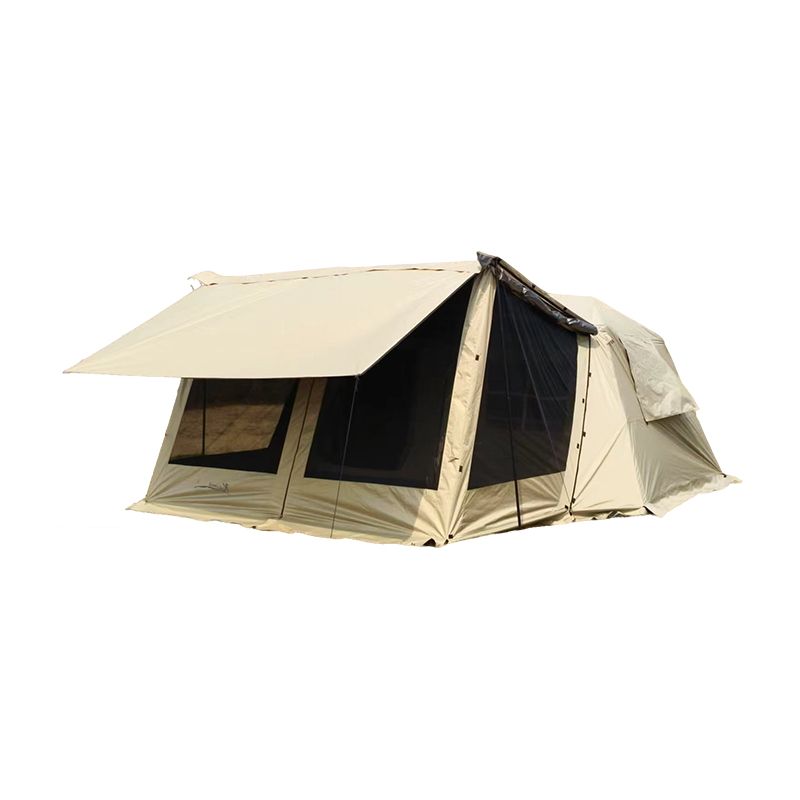
A useful illustration of how these design principles come together is a four-person automatic tent built with a boat-shaped profile, measuring roughly 240 by 220 by 120 centimeters. The shape is intentional rather than decorative, since a boat-like outline tapers at both ends, which helps the structure resist crosswinds while still leaving a wide central area for sleeping space. The outer shell uses 210T coated fabric with a PU rating near 2000mm, giving it reasonable protection against rain showers common during park or beach outings, while the inner tent fabric is breathable to keep air moving through the enclosed space. Its frame is built from 6mm fiberglass poles, light enough to carry but firm enough to hold shape after repeated folding, and the groundsheet uses polyethylene material to resist ground moisture and general wear.
Who Tends to Use This Style
This kind of tent generally suits people new to camping, families traveling with young children, or small groups looking for a shelter that can be opened and closed without instructions. Because the boat shape provides a stable footprint even on slightly uneven ground, it works reasonably well for short trips to parks, riversides, or coastal areas where setup time is limited and comfort still matters. The combination of sun coverage and rain resistance also means the same tent can serve multiple purposes across a single season, from a shaded rest spot on a hot afternoon to overnight shelter during a cooler weekend trip.
What Casual Buyers Should Consider Before Choosing One
Not every automatic tent is built for the same purpose, so matching the tent's size and material rating to the intended use is worthwhile before purchase. A tent meant for short beach outings does not necessarily need the same waterproof rating as one intended for overnight stays in unpredictable weather, though a moderate PU coating around 2000mm tends to cover both situations adequately. Weight and pack size are also relevant for anyone walking a distance from a parking area to a campsite, since automatic frames, while convenient, still add some bulk compared to ultralight backpacking tents. For most casual outdoor users, though, the trade-off between slightly more pack volume and a dramatically simpler setup process continues to make automatic tents a practical choice for spontaneous trips, family outings, and short-duration camping close to home.
-
25 Jun, 2026
A truly memorable family camping trip rarely happens by accident — it is built on thoughtful preparation and the right equipment. Choosing the ultimate gear fo...READ MORE
-
06 Aug, 2026
Beach tents have moved from a niche outdoor accessory into a regular part of weekend routines for a growing number of beachgoers. The shift is driven by a comb...READ MORE
-
30 Jul, 2026
Solo Hikers Face a Different Set of Trade-Offs Than Group Campers A hiker traveling alone carries every ounce of gear on their own back, without splitting tent...READ MORE
-
13 Aug, 2026
What An Inflatable Tent Is And How It Holds Its Shape An inflatable tent replaces traditional metal or fiberglass frames with an air-supported structure, using...READ MORE
-
02 Apr, 2026
What Is Really Changing in the Outdoor Tent Industry Right Now? From Basic Camping to Experience-Driven Glamping The outdoor tent industry is undergoing a clear...READ MORE
-
30 Apr, 2026
Sharing a backpacking tent with a partner, friend, or hiking companion changes almost every variable in your gear decision. You are now negotiating two sets of...READ MORE
-
+86-15867893553
- km@kaima-outdoor.com
- 6th Floor, Building 8, Wanyang Innovation City, Baifeng Street, Beilun District, Ningbo City, Zhejiang Province, China.
Copyright © Ningbo Kaima Outdoor Products Co., Ltd.All Rights Reserved.
 Custom Outdoor Lightweight/Packable Tent Manufacturers
