


 English
 Español
 русский
 Deutsch
 عربى

Big Inflatable Tents for Camping: What Buyers Should Know Before Ordering
Content
- 1 Why Air Beams Change the Game for Large Tents
- 2 How Much Space Do You Actually Need?
- 3 What to Look For in Materials and Weather Protection
- 4 Setup Speed and Daily Practicality
- 5 Layouts That Work for Families and Groups
- 6 Common Concerns Buyers Ask About
- 7 Sourcing Large Inflatable Tents From a Manufacturer
When a camping trip grows from a two-person overnighter to a full family or group outing, the tent is usually the first thing that needs an upgrade. Big inflatable tents for camping have become a popular answer to that problem, replacing heavy pole sets with air beams that create tall, open interiors and set up in a fraction of the time. For buyers who source tents in volume, understanding what makes these structures reliable is just as important as knowing how much space they offer.
Why Air Beams Change the Game for Large Tents
Traditional large tents rely on long, heavy poles that are difficult to thread through sleeves and easy to snap in strong wind. Inflatable tents replace those poles with sealed air beams, usually made from TPU or a similar airtight material. When pumped to the correct pressure, the beams form a rigid frame that holds the tent’s shape without the weak points found at pole joints.
This advantage grows as tents get bigger. A four-meter pole tent often needs several people just to hold sections in place while assembling, and a single broken pole can end a trip. A similarly sized inflatable model can usually be raised by one or two people with a pump, and a puncture repair is far easier to handle in the field than a bent pole.
How Much Space Do You Actually Need?
The term “big” can mean different things depending on how the tent will be used. A weekend family camp needs room for sleeping plus bags, cots, and a small table. A group base camp needs standing height and separate living areas. Reviewing real dimensions, rather than the number of people a tent claims to hold, is a good habit for planning. Look for floor area in square meters, peak height, and wall angle, since sloping walls reduce usable space even when the footprint looks generous.
For groups that need camp beds and room to move around, a wide rectangular floor works well, with a peak height of around two meters so most adults can stand comfortably.
Here is a quick comparison of the size ranges we commonly produce:
| Configuration | Typical Floor Size | Best Use Case |
|---|---|---|
| Family dome | 3 m x 2.1 m | Sleeping for 3-4 people with gear |
| Large rectangle | 4 m x 3 m | Group camping with camp beds |
| Tunnel layout | 5.2 m x 3.2 m | Multiple rooms and standing height |
What to Look For in Materials and Weather Protection
The larger the tent, the more it behaves like a sail, so fabric quality and waterproofing matter. Look for thick polyester or Oxford fabric with a hydrostatic head rating that matches your expected weather, taped seams, and reinforced stress points where the air beams attach. Ventilation is another factor that is easy to underestimate: mesh windows and adjustable vents let moisture escape and keep a full tent comfortable through the night.
Inflatable frames handle wind by flexing rather than resisting it. That is why many large inflatable tents perform well in gusty conditions, provided the tent is properly pegged out. You can read more about how inflatable tents handle moisture and what defines an inflatable tent structure to compare your options.
Setup Speed and Daily Practicality
The biggest practical advantage of an inflatable tent is the way it goes up. Unfold the tent, connect the pump, and watch the beams lift the structure. There are no poles to align and no sleeves to fight with. Packing away is just as simple, which matters for families arriving at the campsite late or for rental fleets that turn over tents every weekend.
Comfort follows from the same design. Because air beams support the fabric from the outside, the interior is free of crossing poles. Headroom stays consistent across the full width, so changing clothes and moving around inside feel less like a crawl.
Layouts That Work for Families and Groups
Large inflatable tents are often divided into zones. A family model with a separate living area keeps muddy boots and cooking gear out of the sleeping space. Tunnel-shaped tents make this division easy, with long central spans that can be split into rooms using internal dividers.
For family weekends, a compact 3 by 2.1 meter layout fits sleeping and storage in a single comfortable space.
 Compact Family Inflatable Tent for Weekend CampingThis 3 by 2.1 meter inflatable tent suits family weekends, offering a single comfortable space with durable waterproof and UV-protective materials.View Product →
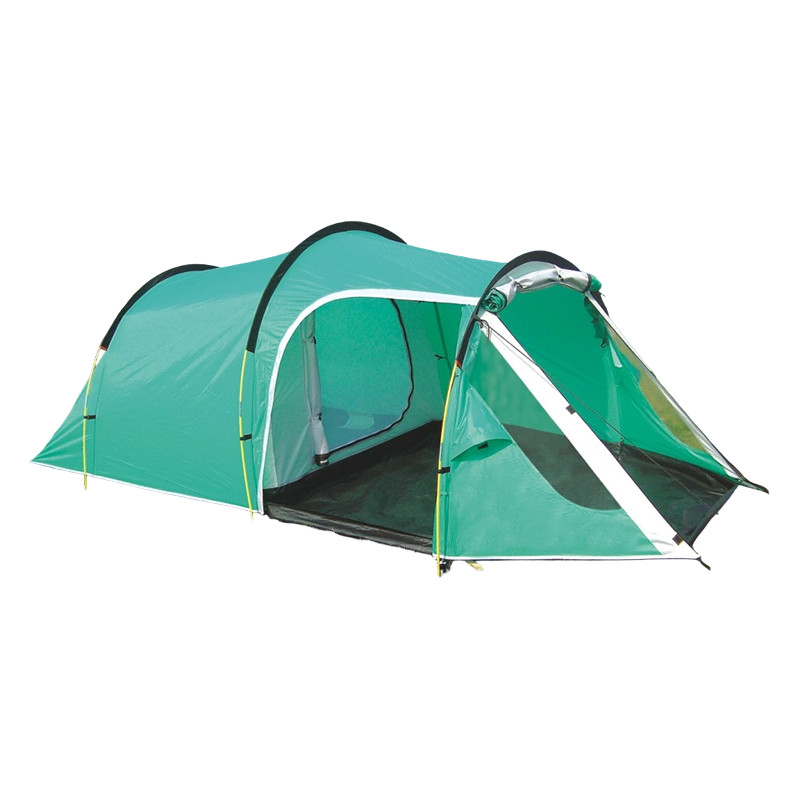
For larger groups, a tunnel configuration around 5.3 by 3.2 meters offers the clearest room separation and the most consistent headroom.
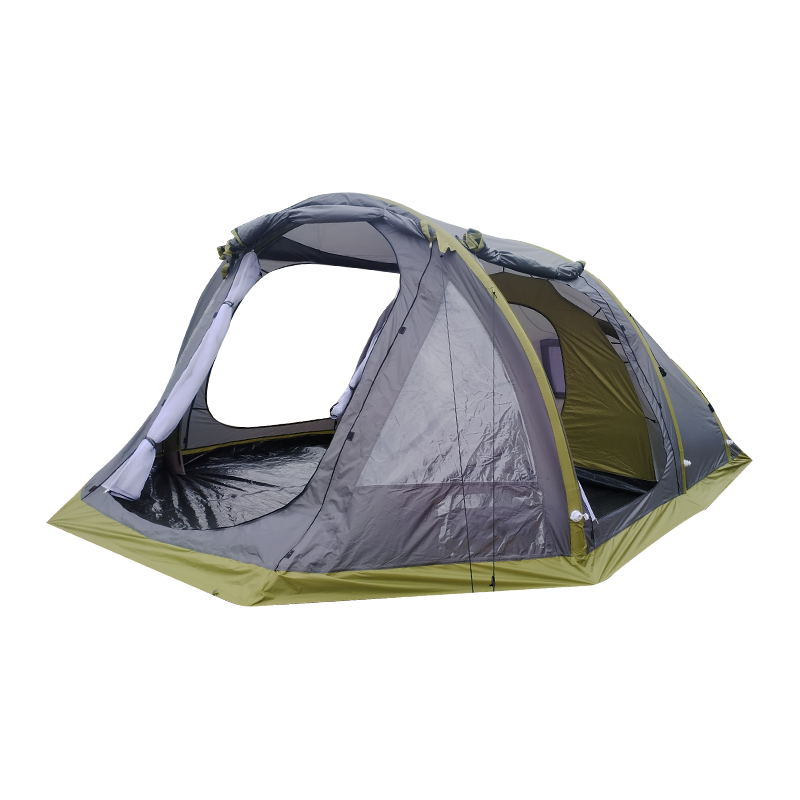 Spacious Tunnel Inflatable Tent for Large GatheringsDesigned for groups, this 5.3 by 3.2 meter tunnel tent provides clear room separation and consistent headroom, with TPU tubes for durability and customization options.View Product →
Both configurations can be customized with extra windows, blackout fabric, or a brand color, which is a common request from our wholesale clients.
Common Concerns Buyers Ask About
Two questions come up whenever we discuss inflatable tents with buyers. The first is cold weather: air beams retain their structure in low temperatures as long as the tent is not inflated beyond its recommended pressure, and the fabric, not the beams, provides most of the insulation. The second is repair. A small puncture in an air beam can be fixed with a patch kit, and spare tubes can be ordered alongside the tents so your customers never wait long for a solution.
Sourcing Large Inflatable Tents From a Manufacturer
At Ningbo Kaima Outdoor Products, we have spent more than two decades designing and producing camping tents, and inflatable models are a growing part of our factory output. We control the process from raw fabric to finished packing, with full-process monitoring and in-house testing for waterproofing and wind resistance. That means when you approve a sample, the production run will match it.
If you are planning to add big inflatable tents for camping to your catalog, a camp project, or a rental fleet, we would be glad to talk through sizes, fabrics, pump systems, and custom branding options.
-
13 Aug, 2026
What An Inflatable Tent Is And How It Holds Its Shape An inflatable tent replaces traditional metal or fiberglass frames with an air-supported structure, using...READ MORE
-
25 Sep, 2026
Two in the morning. The tent walls are beaded with moisture, the sleeping bag feels damp, and the air inside is stale. This is a familiar scenario for campers ...READ MORE
-
16 Apr, 2026
body { font-family: Arial, sans-serif; color: #222; background: transparent; margin: 0; padding: 0; } section { margin-bottom: ...READ MORE
-
14 May, 2026
A blackout air tent combines two of the most significant innovations in modern camping shelter design: inflatable air-beam technology and light-blocking fabric....READ MORE
-
05 Jan, 2026
According to the newly released Global Outdoor Equipment Market Report, driven by new trends like "micro-cations" and "solo camping," the global demand for ligh...READ MORE
-
18 Sep, 2026
You unzip the tent, and the smell hits you first: damp earth, condensation, and the faint sour note of a storm that passed two nights ago. A tent that has been...READ MORE
-
+86-15867893553
- [email protected]
- 6th Floor, Building 8, Wanyang Innovation City, Baifeng Street, Beilun District, Ningbo City, Zhejiang Province, China.
Copyright © Ningbo Kaima Outdoor Products Co., Ltd.All Rights Reserved.
 Custom Outdoor Lightweight/Packable Tent Manufacturers
